Ecofeminism, Subsistence Living & Nature Awareness

June 14, 2012

Gumption and Grit Grabs the ONF Board’s Attention!

Filed under: Ecofeminism, Economics, Paula Mariedaughter — Paula Mariedaughter @ 12:12 pm

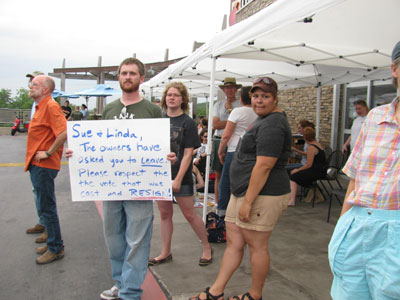
On strike at ONF, June 11, 2012.

Ozark Natural Foods, our coop, was shut down by striking employees on June 11! Yes the doors are locked on a Monday morning!

“Closed until further notice,” the voice on the answering machine for ONF informed me! The staff of Ozark Natural Foods was on strike demanding the resignation of two of the board members who have in recent months participated in firing Alysen Land, long time general manager, attempted to change bylaws and hired an unscrupulous lawyer. Gumption and grit fueled their actions! Many of the staff had sent letters and signed a petition in support of the general manager, and voiced their opinions at board meetings and owner meetings. Most all of the staff are also vested owners of the coop and believe strongly in the cooperative model of doing business.

These women and men were as frustrated as I have been in trying to communicate our desires to the seven people on the board of directors of ONF. This new board (seated in April, 20012) has been dealing with trying to fix the poor decisions of the previous board. (Note: five of the board members are holdovers; two are newly elected including the president.)

On strike at ONF, June 11, 2012.

Staff members carried signs expressing their demands to the board.

After the last ONF’s owner’s forum on June 2, I wrote this to a friend:
“The board has, in fact, set itself apart from the member/owners. It all feels very patronizing–the board seems to believe they must hoard information and make the decisions for the peasant membership–all the while hiding behind “legal vulnerability”. (Remember the legal system is set up to protect the status quo, and those in power benefit most from the legal system.)Delay, postpone and stall seems to be working! The situation seems very discouraging–unless someone takes up the banner and does protests outside the store or something.”

Bold action!

Well, someone did take a bold move–the staff closed the store! In the letter posted on the ONF website and in the flyer handed out in front of the store, the staff described their frustrations and their demands of the board. Sixty staff voted on Sunday, June 10 to close the store and to hand out information on Monday to all who came to the store (see a copy of this letter below). They announced their intentions to the media on Sunday evening. The interim general manager Mike Anzalone, who worked under Alysen Land as store manager, was one of the strikers.

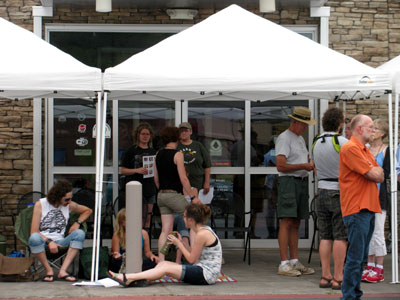
Monday morning was bright and sunny. The staff erected four ONF tents to shield them from the blazing sun and from the rain predicted later in the day. The tents lent a festive feel to the somber, yet determined, action these women and men chose to take believing they were acting in the long-term best interest of their coop. I agree. Their letter lists no demands for raises or improved working conditions. Arkansas is not a state known to be sympathetic to the needs of employees. And these workers did not even have the protection of a union. Each of the staff took a personal risk because they believed the board was not hearing the voice of the owners and the staff.

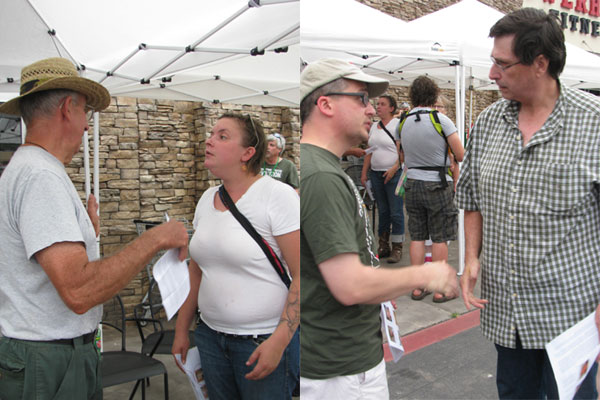
Staff explaining their actions to shoppers

Dialogue between ONF staff members and concerned shoppers.


President of the board with staff.

President of the Board of Directors, Joshua Youngblood, (on left) talking to staff members before the Monday afternoon meeting to discuss the demands of the striking workers.

Early Monday when we heard about the strike, Jeanne and I headed to town. We had been to board meetings and owner forums. We created a handout in May and passed it out to other shoppers–one of these is still on the bulletin board. I called everyone I can think of to ask them to email the board. All this seemed futile, until the employees united and made their strong voices heard.

We talked to the strikers and listened to their stories. I also spent about two hours talking to shoppers and owners who came to ONF. I explained that as a long-time owner, I had gone to the meetings, read the previous board minutes for the last year and still felt like I only had a small piece of the puzzle. That’s why you will see me standing with the sign. Most people were supportive and understanding. Some even asked how they could help.

The personal is political and the political is personal!

As an ardent radical lesbian feminist I observed several principles during all this. We know that, “The personal is political, and the political is personal.” I interpret this to mean that each of my personal choices—say to not eat meat—has additional political implications. A vegetarian diet uses far fewer resources to keep this one human alive. Animals will not be mistreated to offer me meat calories. Long-term healthcare costs are generally lower for non-meat eaters, etc. Additionally, all my political choices have personal implications and responsibilities. When I advocate for reducing our carbon footprint as a nation and as a species, it means my personal choices are going to be affected—no more jet plane trips, choosing to live without using air conditioning in my home, etc.

Come sit with us...

Come sit with us.... It was a long, stressful day for ONF staff who tried to make the best of the situation..

Taking a personal risk of losing one’s job because you believe your risk may correct a political situation in a positive way is a powerful statement. Taking personal power is a heady choice as we have seen in those involved with the Arab Spring uprisings. Exercising personal power is a risk. Collective action can change your world!

Positive outcome

The ONF Board of Directors has not taken retaliatory action (although I have heard that some on the board suggested this). In fact, the board by a four to three vote has chosen to rehire Alysen Land as general manager for the next year! I am pleased. The staff is relieved. However, her boss will be this severely divided board of directors. It will not be an easy year, but if feels like a hopeful move on the board of director’s part. I appreciate each of the directors who voted to hire the best person for this job. Their job has not been an easy one. The next few months will present more challenges. We, the owners at ONF are the only “boss” of the board. We need to be informed and involved in order to keep our coop strong.

I believe the board could benefit from radical feminists’ concept of power. We differentiate between “power over” and “power with”. “Power with” is the essential willingness of people to work together to create solutions to all the situations that face humans. “Power with” models depend on consensus decision-making where the voices and concerns of all are heeded as important and valid. The hierarchy that produces more attention to “prominent citizens” and “powerful men/women” is not reinforced. “Power over” models depend on top down rule-making and depends on fear to keep people in line.

Avoiding a discontented minority

We live in a culture where the “majority rules”. Consensus may take more effort to achieve. But those of us who believe in the consensus model are well aware of the damage the dissatisfied minority usually creates in ongoing disputes where the majority attempts to impose their decision on the others. This is my fear about the current situation with a severely divided board of directors. I know that the current president has made determined attempts to have the board “speak with one voice”. I have no easy answers. My observations are that the current methods of decision-making and communication are not working. Spontaneous cooperation is our goal. Let’s brainstorm about what would help make us all more willing to spontaneously cooperate.

On strike at ONF, June 11, 2012.

Paula's first strike experience was in 1971 striking as a flight attendant against Trans World Airlines (TWA)--she needs to keep up her striker credentials!

The staff wrote this letter to the public explaining their actions. The letter was posted on the ONF website and passed out during the strike. Many of you may not have had the chance to read it. I value this letter because it is strong, simple and clear.

Letter from the Coop staff addressed to Co-op owners:

We, the staff of your co-op, Ozark Natural Foods will no longer stand by while your voices and the will of the staff remain ignored.

A group of owners asked for a special meeting in order to discuss the conduct of Linda Ralston and Sue Graham. The owners were denied that meeting. The owners chose to meet anyway. Those owners met quorum; voted to remove both board members, and submitted those results to the board of directors. Linda Ralston and Sue Graham remain seated against the will of the membership.

The majority of the staff wrote letters to the board of directors and overwhelmingly signed a petition for the reinstatement of Alysen Land. That request has not been acknowledged.

We, the staff of Ozark Natural Foods, believe that our co-op is in crisis. We will no longer stand by while we are hushed like children and told to be quiet while the adults in the room decide our fate.

As of the close of business on Sunday, June 10, in the spirit of passive resistance, the doors of the co-op will be locked; and before you we will sit down. We refuse to work under these conditions. We refuse to continue as if nothing is wrong, while the basic tenets of co-operation are being ignored. We will fight for the co-operative principles, for transparency, and for the voices of the ownership and the staff to be respected. Because we insist that the vote of the ownership be respected, we sit before you with a single goal:

We demand the resignation of Linda Ralston and Sue Graham.

We believe that it is impossible for our board of directors to carry on a reasonable relationship with this management team, with the staff, and with our ownership until Linda Ralston and Sue Graham resign. We believe that in their absence, Alysen Land will be returned to her postion as General Manager; that John Eldridge will be removed and an attorney who is willing to defend our bylaws will be hired; that our mortgage will be paid in full as we promised the ownership many months ago. We believe that in the absence of Linda Ralston and Sue Graham, our ownership and our community, rather that personal agendas, will once again become the focus of our board of directors.

We sincerely apologize for the inconvenience this will cause to you and to the interruption in your ability to get wholesome food for your families. But we believe that the very nature of co-operation is now in jeopardy. We ask you, our owners, our friends, our family, our community to please sit with us in protest.

We ask that you contact all of our board members and plead for the resignation of Linda Ralston and Sue Graham. We hope for a speedy resolution so we can return to being your community owned co-operative grocery store.

May 12, 2012

Cooperative Principles Gone Awry

Filed under: Economics, Paula Mariedaughter — Paula Mariedaughter @ 8:02 am

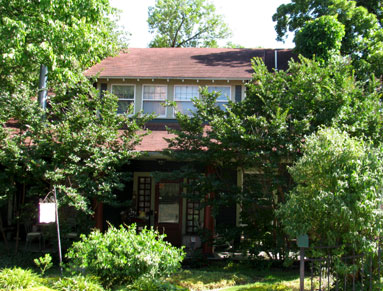
Rock St

Ozark Natural Foods, our coop, used this location on Rock Street in the 1980s. The house was funky, cramped and cozy.

About Consumer Cooperatives, aka a Coop
Consumer cooperatives are a direct challenge to capitalism. We owners do not receive profits from this business model! We contribute a particular amount of money to become an owner—this is our owner equity in the coop business. Currently it is $140 at ONF which can be paid at $20 per year–and we can withdraw the entire amount later, if we choose. If a cooperative pulls in more money than the cost of goods, services received, and employee salaries, all that money is returned to the owners. This returned money or, as our coop calls it, “patronage refunds” is not profit pulled from employees salaries, extracted from suppliers or the result of selling poor quality goods as many of the big-box retailers operate. This patronage refund returns to owners money they spent at the coop during the last year.

At times, the general manager and the board may choose to keep back part of the owner equity to cover planned expenses or unexpected expenses. The board votes each year on what percentage will be returned. Usually 20% is returned and 80% retained to be returned at a later date. Some coops don’t return the retained. However, during general manager Alysen Land’s watch, the funds have been to returned to owners within 7-10 years after they were first retained. This all depends on the financial health of the coop.

Dickson St

ONF moved downtown to the Dickson Street location in 1993.


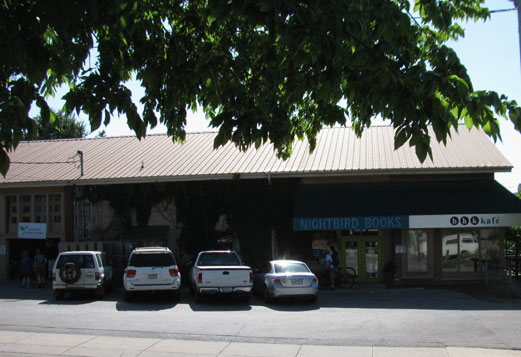
current location

ONF moved to this current location in Evelyn Hills Shopping Center in 2000 and has since purchased the building.

About My Coop, Ozark Natural Foods
ONF began as a coop in 1971. I began shopping there in the early 1980s when I first bought land in the area. I became an owner before I even moved to northwest Arkansas. The first place I remember shopping regularly was the cramped house located on Rock Street across from the police station. It was a funky little store with some severe management problems. After a long financial struggle the store recovered. In 1993 ONF moved to a downtown commercial location on Dickson Street. There the store grew, but parking was limited. After the move in 2000 to Evelyn Hills Shopping Center and the financial crises involved that year, the current general manager resigned and Alysen Land was promoted from within to the general manager position.

With the help of a financial consultant and some drastic cuts, the coop struggled to reduce its debt. Within six months the financial picture was improved. ONF, under the leadership of Alysen Land, has gone on to win national awards and now has an excellent credit standing. Recently ONF has purchased the entire building allowing for the possibility of expansion. Current plans project paying off that mortgage by fall of this year! Would you fire a general manager who has accomplished all this? I would not! I would give her a raise!

Firing a Successful General Manager for “No Cause”
On March 22, 2012, the previous board of directors of ONF fired general manager Alysen Land for “no cause” in a four to three vote by the board. We, the owners did not receive any official word of the firing and the employees were warned by the board not to talk about it at the store. Rumors abounded. I was shocked and then outraged the more I looked into the situation. Below is my letter to the board of ONF. This is a board with some new members. I urge you to write your own letter to the board: board@ozarknf.coop

Dear Board Members,
Ozark Natural Foods is one of the main reasons I live in northwest Arkansas! As a member since the early 1980’s I have watched the many transformations that bring us here today. The board is answerable to the owners—that means we need information about important board actions. As one of the owners, I expect to be allowed to attend any meeting of the board when the board is conducting Coop business. I expect the Coop Newsletter to inform me of important Coop news –like the board decision to fire general manager Alysen Land last March. Keeping vital news of board actions from the membership does not serve the owner’s best interest.

I attended the so-called Owner’s Forum last Saturday and was sorely disappointed in the tone and content of the board response to our owner concerns. Many of us care deeply about the ongoing health of Ozark Natural Foods. We have trusted Alysen Land and her leadership team for the last twelve years. The board gave us no information to make an informed judgment about the wisdom of the board’s action to terminate her contract.

In light of your actions to date, I am doing everything in my power to inform owners and other community members of the current situation at ONF and encourage both owners and shoppers to seek out the truth.

I sincerely hope that the board will reinstate Alysen Land at the May 15 meeting and I encourage you to give her an apology for all the previous board has put her through. Additionally, I believe a well-earned raise is in order! I also hope this board will eliminate the restrictions place on discretionary spending imposed by the previous board. I urge you to hire legal counsel who respects coop principles.

Unannounced and secret board meetings serve to heighten suspicion and mistrust. An open meeting policy would go along way to healing the rift the previous board created.

Best regards, Paula Mariedaughter

August 24, 2010

Fracking Brings a Living Hell to Earth!

Filed under: Ecofeminism, Economics, Patriarchy, Paula Mariedaughter — Paula Mariedaughter @ 6:59 am

bale1

Gasland is a documentary movie by Josh Fox who was approached about leasing land near his forest home for gas drilling.

The documentary film Gasland (www.gaslandthemovie.com) introduced me to the people who are living in the earthly hell created by the extreme drilling technique, called fracking, currently favored by the major gas companies who dig 8,000 feet, inject water laced with 596 chemicals (many are very toxic) to pump up natural gas mixed with the water and chemicals. Once the gas is separated, the 7 million gallons of chemicalized water from that one well is a hazard we all have to live with. The closest neighbors to the well—more often multiple wells—will breath the toxic chemical fumes, drink those chemicals in their water. We met those people and heard them describe the severe health effects for themselves, their children, pets and all of nature unfortunate enough to live near polluting gas wells. Endocrine disruption, cancer, asthma and severe headaches are just a few of the results of exposure to the contamination of the air, soil and water caused by the gas drilling industry. Dr. Theo Colborn, a leading expert on this subject has more information available here: http://www.endocrinedisruption.com/chemicals.video.php

My opinion is that this deep drilling technique is fundamentally unsafe because of the chemicals used, the multiple deep underground blasting and the impossibility of obtaining enough water for the process and finally because the trillions of gallons of used water cannot be safely stored or restored as safe water.

No Regulations from Government!George W Bush and Dick Cheney (both oil men) and earlier Richard Nixon convinced congress to exempt the natural gas industry from meaningful regulation. The industry is not covered by:
the 1972 Clean Air Act
1972 Clean Water Act
exempt from Superfund Cleanup
exempt form Safe Drinking Water Act
needs to provide minimal environmental impact statements

The industry is dominated by several big companies (including Halibuton) who have no oversight—the EPA has no authority to regulate drilling. You may not be aware of the scale of the environmental destruction, even if you are aware of some of these problems with gas drilling. Thursday afternoon I was aware of the problem, but unaware of the scale of the problem. By Thursday evening I had seen images of hundreds of square miles stripped of life and dedicated to pulling gas from deep within the earth and destroying peaceful life in the process!!

After viewing the reality, I could not sleep—haunted by those images. And I was haunted by the faces of the people trapped by circumstances! They had been lied to and treated without regard for their health and safety. It could have been any of us. This was not a natural disaster, but an un-natural disaster, a man made disaster. No one protected them. Some were told to hire an attorney and sue if they felt wronged.

In fracking, the blasting creates mini-earthquakes that blast open underground cracks to release the gas. We are told these blasts are harmless, but do we know that? No, this extreme drilling process has only been in wide use for ten years. Can the earth sustain this assault? Will the earth sustain this assault? Our clean water comes from underground aquifers of ancient water, how will these nonrenewable resources be protected?

And where will the water to perform the drilling come from? How will the toxic water be stored safely forever? Each well drilling requires from 1-7 million gallons of water. The same well can be tapped up to eighteen times and will use that much water each time. Using the low estimate of 1 million gallons per drilling, that would be 18 million gallons of water per well. In the Dallas/Ft. Worth area there are 10,000 gas wells. Again, using the low estimate, 18 million gallons of water multiplied by 10,000 wells equals 180,000 million gallons of poisoned water to store and protect. This is only for the wells in the Dallas/Ft. Worth area!

Water shortages are already predicted to be a major concern worldwide. Safe drinking water will be the luxury of the future, if we do not make major changes now!

Your well and my well, could they be next?
My concern is not merely an intellectual concern. Last year the national forest service leased forest land 30 miles or so south of here to a company determined to use fracking to drill for gas in the national forest. The owners of the nearby resort, Mulberry Mountain, called our attention to the situation and arranged for a public meeting with local officials. The process was described and the concerns and protests we offered were ignored. My understanding is that the drilling has begun and soon there will be 1-7 million gallons of toxic water used in the drilling waiting to be disposed of somewhere. Where and how?

water-tank

We collect water from our roof for our garden and store it in these open stock tanks. Even this water can be polluted by the chemicals in the holding ponds of polluted water vaporizing into airborn chemicals and released as acid rain.

The gas companies have a legal strategy called “forced pool” that can deny people to decline drilling on their land! Many of us do not own the mineral rights to our land, or own only a percentage of the mineral rights. Imagine the complications this could bring to a landowner not wanting to lease to gas drilling companies.

We could be next! Several years ago, Jeanne and I were contacted by a gas company representative who told us they wanted to drill on our land. Neither we, nor our neighbors were interested. Fortunately, we have not heard from them in years. We have 40 acres of oak/hickory forest where we built our solar powered house and began our organic gardens twenty-one years ago. We love where we live and have invested heart, mind and soul here. Josh Fox, who created Gasland, began his search to learn more about gas drilling because he lived in a similar rural area in Pennsylvania, where his parents had settled in the 1970s. He grew up in the woods and especially loved the stream that meandered through his homestead. The gas company offered him $100,000 for drilling rights. He wanted to learn more. He sought out landowners who had agreed to lease to the gas companies. Gasland showed us streams near drilling sites that are polluted with gasses from the drilling and have pockets of gas in the stream that can be lighted on fire. Often the deep underground blasts force new seams to appear in the underground rocks sending gas and methane formerly trapped underground into pristine wells, springs and streams. We heard people describe all this in Colorado, Pennsylvania and many other places! His worst fear and our worst fear! These were real people stuck in a living hell.

Foolishness
Don’t be fooled by the PR campaign financed by the natural gas corporations that declare gas to be a “clean” energy source. The 10,00 wells around and in Dallas/Ft. Worth emit 200 tons of toxic emissions per day—more than the automobiles in that metropolitan area emit each day. And, the natural gas pipelines have built-in release valves that we are told are not toxic, but it is gas released into the atmosphere on a regular basis, yes?

We need to educate ourselves, our neighbors and our political representatives about all the consequences of fracking. However, the gas companies are big campaign contributors, so we may have to become more creative in letting the politicians know of our outrage that the gas companies call all the shots and we, the people, are left to fend for ourselves.

Stop using natural gas is another radical possibility! Radical means going to the root of the problem. If there is no market for natural gas, the gas companies have no incentive to drill. Build a clothesline! Gas clothes dryers were not common place in Miami Springs where I grew up in the 1950s. We were a family of six with lots of wet clothes and they were all hung out to dry. Put up a clothesline and hang your wash. Change those ridiculous city regulations that forbid clotheslines if you have such restrictions.

I am not a politician, so I can and will express my unpopular opinion: reduce, reduce, reduce. Conservation of all our natural resource use is the central component in saving our planet from the extreme climate changes we are heading for today. Reduce your consumption of all energy sources: batteries, electricity, oil, gasoline, propane, as well as plastic and water and food. Perhaps we can reverse the consequences of our dependence on unlimited access to energy sources. Walk in the woods. Ride a bike. Grow a garden. As my mama used to say, “Actions speak louder than words”!

fern913

Destroying habitat of millions of plants and animals from Texas to Ohio and from Pennsylvania to Colorado to extract gas to fuel consumer lust for luxury must stop. Our garden reminds me of how plants and people have coexisted for thousands of years, until now.

For more information about the drilling practices of the natural gas industry proceed to these resources provided by Joyce Hale, president of the local chapter of the League of Women Voters. The screening of Gasland in Fayetteville was sponsored by the League of Women Voters, Omni Peace and Justice Center and the local chapter of the Sierra Club.

Learn More about Natural Gas Development and Take ACTION!
SIGN UP FOR FUTURE EMAIL ACTION ALERTS

1. ProPublica online articles
http://www.propublica.org/search/search.php?q=natural+gas&x=10&y=13.
They have intensively developed the topic over the last couple of years. Their investigative reporting is some of the best out there.

2. Become acquainted with everything on the subject at endocrinedisruption.com/. Dr. Theo Colborn is the go-to person for information about the impact of chemicals, particularly on children and the unborn. http://www.endocrinedisruption.com/chemicals.video.php

3. Make sure that any landowner facing the decision to lease is familiar with OGAP (Oil & Gas Accountability Project). Their free manual, Oil and Gas at Your Door, http://www.earthworksaction.org/LOguidechapters.cfm should be the bible of everyone interested in this topic.

4. Blogs will give you local insight and help you connect with where the action is having negative impacts. Check out:
http://www.a4gda.blogspot.com/ (Arkansas)
http://txsharon.blogspot.com/ (Texas)
fwcando.org/ (Texas)

5. Videos are a wonderful way to learn:
a. Split Estate - This documentary about Colorado and New Mexico features the conflict between surface ownership and mineral rights. Health problems are a key part. If you get this video www.splitestate.com, be sure you watch the “extras” in addition to the main feature
b. Gasland - Film maker, Josh Fox, gained a high profile after winning at Sundance Film Festival and became popular guest with national television interviews. There are HBO showings still being scheduled so check the HBO Documentary section for listings. Copies should be available to buy in December. Go to www.gaslandthemovie.com for information.
c. What You Need to Know About Natural Gas Production - An excellent description of the process and chemicals by Dr. Theo Colborn. It is available at her website or they will send you a DVD. http://www.endocrinedisruption.com/chemicals.video.php
d. But MOST IMPORTANT is a MUST WATCH 3-part video by the Cornell Professor Anthony Ingraffea, revealing the true economics and scale of this problem. http://nyrad.org/videos.html This is possibly the most critical thing to be understood, since it is the only argument that will resonate with the political leadership. They must be shown that they have been listening to one side of the economic equation.

TO REQUEST A PROGRAM ON NATURAL GAS DEVELOPMENT IN ARKANSAS FOR YOUR GROUP OR ORGANIZATION:
Contact JOYCE HALE 479-527-2777 or joycehale43@gmail.com

striper878

Gasland documents severe health problems for people, domesticated animals, and wild animals when exposed to toxic water, fumes and noise related to gas drilling. Children developed asthma, others experienced severe headaches. Endocrine problems were common complaints of those living near drilling sites. Some of the animals lost much of their fur. Striper is one of our seven household animals we are concerned about.

Postscript from Paula: Here at Cedar Hill we heat our 800 square foot house with locally purchased seasoned firewood, and do not use air conditioning. Solar energy collected from eight vintage solar panels located on our roof provides our electricity including the biggest energy hog: refrigeration. (We do use a Sunfrost refrigerator which operates off a 12 volt system like ours and is built to be super energy efficient. We do not have enough solar electricity to operate the freezer unit.) Propane is the energy source we use to cook and bake, although in winter when we have our wood stove burning we heat water and cook some food on the woodstove. We consider this bonus energy! Our 100 gallon propane tank lasts us about nine months. We have had to do some research to find out where and what propane is. Do you know?

Propane is a gas often found with natural gas and even with petroleum deep within the earth. Some sources name it as a by product of processing natural gas and of petroleum refining. The processing of natural gas involves removal of propane and butane from the natural gas, to prevent condensation of these liquids in natural gas pipelines. Additionally, oil refineries produce some propane as a by-product of production of gasoline or heating oil.

Because we want to reduce our use of natural gas to a minimum, this means that one of our goals is to reduce use of propane in every way possible. Instead of heating water on the stove for our showers, we are now depending more on using the sun to heat the water in our solar shower bag for a refreshing hot shower. We will wash our laundry in Fayetteville tomorrow because we are going there to do our grocery shopping at Ozark Natural Foods Coop. To avoid burning all the natural gas it would take to dry our clothes (and the electricity used to turn those large tumblers) in the gas dryers, we will hang everything here in the hot August sun to dry. Actions speak louder than words….

August 2, 2010

Are We Trapped in Recreational Shopping?

Filed under: Ecofeminism, Economics, Subsistence Living — Paula Mariedaughter @ 6:43 am

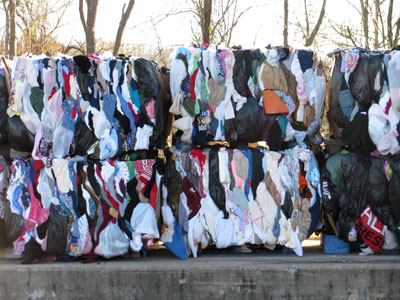
bale1

This huge bale, or mitumba, of fabric heading out of sight

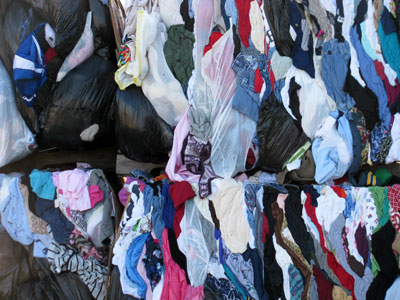
I shop for treasures in unlikely spots. I enjoy my time browsing through thrift shops and flea markets. As a lifelong admirer of quality fabric, textiles are a weakness for me. I can almost always think of a possible use for an attractive piece of cotton or silk. As a quilter, the range of possible uses for a particular pleasing textile is unlimited. I love fabric—whether it is a richly colored teeshirt, a vibrant plaid, a large scale floral or a swirling batik, I want it in my life! Imagine my shock when I arrived at the parking lot of the local salvation army and saw tons of fabric compressed like junk into two huge bales. Each bale was as large as a railroad car! At first I did not know what I was looking at: it seemed to be new wall beyond the building. I looked closer and grabbed my camera because it was an unbelievable sight. When you look at the pictures I took that day, you will see the fluttering corners of hundreds of white plastic bags among the flattened clothes. I experienced it as a chilling, unworldly sight.

As a regular shopper here, I had never seen such a sight. When I inquired inside, I was told that they ship several bales this size every week. They send it “overseas”. The worker explained that most of the clothes they receive as donations will not be purchased, so they move it on as quickly as possible. In a recent book, Fred Pearce wrote, “On average, each of us buys around 75 pounds of textiles a year. We eventually throw about 65 pounds of that into the landfills and hand over about 10 pounds to charities….” It seems that most of those charities bale up most of their donations and many sell the bales to raise money for their other projects. Often the bales are sold to importers in African nations who then sell the individual items to poor people for a profit (emphasis mine). “In Tanzania, they call old shorts and shirts and skirts and socks mitumba, meaning a bale. That’s how the clothes come, in bales unloaded from shipping containers at the Dar es Salaam dock.” Mitumba is big business in Tanzania where most of the ordinary people wear the Western world’s cast-off clothes. This invisible connection to the consuming lifestyle of most Americans has been traced by Fred Pearce in Confessions of an Eco-Sinner: Tracking Down the Sources of My Stuff. The author offers you an extensive research on the life of stuff once it leaves your hands.

bale2

Closeup of the bale with all the flapping plastic bags

Compulsive consuming often involves “recreational shopping”. Recreational shopping was a central part of my girlhood and family life in the 1950s and 1960s. What is recreational shopping? The easy definition I use describes recreational shopping as something to do when you are feeling down, something to do to celebrate an occasion, and something to do if you are just bored and want to get out of the house. Shopping becomes central to existence.

I noticed this recreational shopping phenomenon in my own life only after I became actively involved with the Women’s Liberation Union in Kansas City, MO in the early 1970s. There I learned about the power of capitalism to dominate the lives of us ordinary people. At the same time my mother had been divorced by my father and was struggling financially. She observed, “You can’t go out of the house without spending money!” She was experiencing the limitations of her reduced income, and noticing a phenomenon she had not seen before in her own life. These were the early days of consumerism—credit card use was not yet wide spread. Today we are now consumers rather than citizens or neighbors. We live in markets, not cities or towns. Have you even noticed this change in terminology in the media?

My values and consciousness were changing as I examined many parts of my life. My good friend Kate Kasten wrote a guide to the thrift shops in the Kansas City area in the mid-1970s. We enjoyed searching for “finds” and “necessities” along Main Street’s bargain spots. When each of us purchased vintage houses in downtown KC we shopped for furniture and appliances with a past life. It was great fun for me to search for items that caught my eye and pleased my sensibilities. I was not buying what was being promoted at the furniture and department stores. Often I bought better quality than was available new! I furnished my 1888 Queen Anne Victorian house with style!

Thirty-five years later I still get a thrill looking for unique items at thrift stores and flea markets. Fashion is irrelevant to my life. Quality fabrics and well made furniture and tools draw my attention. I do enjoy shopping, but I avoid any, and every big-box store. The majority of my clothes are treasures I’ve found at thrift shops. One of the advantages of shopping where clothes cost five dollars or less is the freedom to not wear something uncomfortable. One cannot always tell how comfortable a particular item will be until worn in real life. If it doesn’t work out, I can wash it and redonate it to the thrift shop. Many of us have a few things in our closet that have become our favored outfits because we feel good when we are wearing them.

jacket

Paula is outfitted in her second-hand clothes and feeling good.

Here is my favorite outfit. The picture was taken as I stood by the special exhibit I pulled together for our quilt guild’s 2009 quilt show. The blue knit shirt, the cotton slacks and the black and white ikat unlined jacket all came from thrift shops. I have worn the slacks, shirt and the jacket regularly for at least the last eight years. They will not be donated to a thrift shop any time soon. Shoes, underclothes and well-fitting pants are items I generally purchase new. I choose carefully and expect each to last a long time. I stopped wearing fashionable women’s shoes in the 1970s because of the long-term damage such footwear does to women’s feet. At the time I worked as a flight attendant for TWA. The airline required me to carry the doctor’s letter declaring I needed to wear the low heeled, lace-up leather shoes for health reasons. My flying partners sometimes couldn’t resist making comments like, “Those shoes look (long pause) comfortable.” We worked long hours and walked many miles, but fashion trapped many of my women coworkers in uncomfortable shoes.

How did I make drastic changes in my life? Radical means “finding the root” and I was part of a movement of women who looked for the roots of sexism, racism, heterosexism, ableism, colonialism and capitalism. We read, talked, argued, laughed and grew together. I consciously chose to limit my exposure to advertising and to the content of television after reading Four Arguments for the Elimination of Television, I gave away my second hand tv in 1974 and I’ve never missed it. Fads, fashion, celebrity gossip, and catchy commercials are not part of my life. However, I still am a consumer on many levels: driving a car, using a telephone, buying food at the farmer’s market or at our local food coop. All these require my participation in the capitalist economy.

Yet, I have successfully limited my participation emotionally and financially in our consumer society. Adrienne Rich clarified my efforts when she wrote, “The most valuable educational experience a woman can have is one which teaches her to identify and analyze—and resist—the conditions in which she lives, the morality she has been taught, the false images of herself received from high art as well as cheap pornography, classic poetry as well as TV commercials.” This is my ongoing effort: to identify and analyze oppression and injustice and to resist. Often I turn to the garden for renewal.

January 24, 2010

My Fair Share

Filed under: Ecofeminism, Economics, Global Warming, Jeanne Neath, Patriarchy, Subsistence Living — Jeanne Neath @ 8:38 am

With “developing” and wealthy nations now battling over obtaining their fair share of global carbon emissions, the belief that all people will someday enjoy the standard of living of the wealthy nations has become an unmistakable fantasy. Human societies are already in overshoot, consuming the resources of one and a third earths every year. If everyone on earth were to consume as much as people in the United States, humanity would be consuming the resources of five planet earths and there would soon be little of nature – or us – left. Yet the rising and very numerous middle classes in rapidly industrializing nations such as Brazil, India, and China are joining the shopping spree. Meanwhile one fourth of humanity, 1.4 billion, live on $1.25 or less per day and are unable to meet their basic needs.

The belief that the poor nations and poor people of the earth would eventually catch up and enjoy an abundant standard of living has allowed well-meaning people in the wealthy nations to act as if their own high incomes and consumption were unrelated to the poverty of others. Now that the limits of the earth are at hand the question “What is my fair share?” is getting tough to avoid. I want an answer to this question. I don’t want to participate in destroying nature and I don’t want to be responsible for other people living with hunger. But, I do want to live. How much can I have?

heirloom corn

Stowell's Heirloom Corn from Seed Savers growing behind comfrey, astragulus, and sage plants.

To discover my fair share I started with statistics from the World Bank (World Development Indicators: 2008). The average per capita gross national income for the world in 2008, equalized by “purchasing power parity”, was $10,357. The purchasing power parity correction makes it easy to compare income in different countries, despite the fact that the same amount of money can buy much more in some countries than others. For example, you could buy half a dozen bananas in India for the same amount of money that would get you one banana in New York City (example from Norm Myers and Jennifer Kent in their book The New Consumers). The purchasing power parity correction rate for India is 5.35 (as of 2002). The international standard is the U.S. dollar so the same amount of money goes 5.35 times further in India than in the U.S. In other words if you are in the U.S. you can think of the $10,357 average world income as actual U.S. dollars. If you are in any other country, then you must use the purchasing power parity correction for your country.

But, the figure of $10,357 is the average gross national income, which is not the same as personal income because it includes things like the average amount of money your government spends on infrastructure. In 2008 gross national income in the U.S. was $46,970, but U.S. personal income before taxes was $40,189 and spendable income was $35,486 (Bureau of Economic Analysis, bea.gov). According to Myers and Kent, actual purchasing power for the world in 2002 was 60% of gross national income, corrected for purchasing power parity (and 70% for the U.S.). Let’s say then that my actual purchasing power would be roughly $6500 (somewhere between 60% and 70% of $10,357).

Whoops! What about Carbon?
But, wait! There’s a problem. At current levels of world income humanity is producing such a large quantity of greenhouse gases that we are threatening the continuation of human civilization and much of life on earth. The Global Humanitarian Forum, a think tank directed by former United Nations secretary general Kofi Annan, estimates that global warming is already causing 300,000 human deaths per year. To reduce greenhouse gases either income and related production must be reduced from the current world average (meaning I’d get less than $6500), world population must drop significantly, or every dollar spent must result in much less carbon entering the stratosphere. Damage to the environment is commonly calculated by multiplying these three factors (i.e. Impact=Population x Affluence x Technology). Both population (.7% per year) and income (1.4% per year) are growing. The most palatable option for the world’s rich is the third option, commonly known as reducing carbon intensity.

Carbon intensity can be decreased by increasing efficiency (producing goods and services with less energy) and by using non-carbon energy sources like solar power. Over the past 25 years carbon intensity has improved by almost 23% worldwide. But, this downward trend has not been consistent over the years. Since the year 2000 carbon intensity has worsened worldwide. With worsening carbon intensity, increasing income, and increasing population the total amount of carbon going into the atmosphere has increased by 3.5% per year since 2000 (up from under 1% in the 1990s). This rate of increase is far higher than the rates assumed in any of the models used by the Intergovernmental Panel on Climate Change in making its predictions of future global warming. Even with the Kyoto Protocol, no part of the world has succeeded in diminishing its carbon emissions.

Prosperity Without Growth, a recent report from the United Kingdom’s Sustainable Development Commission, has calculated the improvements in carbon intensity that would be necessary to offset projected growth in population and income between now and 2050 and still reduce carbon in the atmosphere down to 450 ppm. While in 2007 carbon intensity was at 768 grams of carbon dioxide per dollar we would need to get down to 36 grams per dollar by 2050. In other words carbon intensity would need to improve by 21 times! Remember that 25 years of technological improvements between 1980 and 2005 were only able to improve emissions 1.3 times (from 1000 to 768 grams carbon dioxide per dollar). This projection allows for slow income growth, but no equalization of income between rich and poor countries. If world income were to equalize at current European Union levels by 2050, allowing no income increases in the developed world, carbon intensity would need to diminish to 14 grams carbon dioxide per dollar, 55 times better than today. This last scenario presumes no income growth in the European Union, a loss in income for the U.S., and large gains in income throughout the developing world.

Prosperity Without Growth concludes that these levels of improvement in carbon intensity are not feasible and that economic growth cannot safely continue. Worldwatch attempted to put similar figures into perspective by pointing out that for everyone on the Earth to live at the EU levels expected in 2050 if “normal” growth continues we would need cars capable of getting 700 or 800 miles per gallon! It looks like even my fair share of $6500 is too much unless a revolution in technology dropped carbon intensity down to nearly nothing. Since new technologies take decades to come into common usage, the hope for such a revolution is just a fantasy, albeit a popular and dangerous one. The only other alternative – and this is just a personal solution – would be for me to find a way to spend my dollars on products and services that emit almost no carbon.

Shrinking Ecological Footprints
Carbon emissions are not the only constraint on growth. Globalized industrial patriarchy has been stripping the earth of every “resource” and is already butting up against other shortages such as water. The resource thieves in the “developed” world, myself included, must cut back their lifestyles. The world average gross income of $10,357 gives us a rough and too high upper limit and a clear message that drastic lifestyle cuts are called for since most people in the developed world have far higher incomes than this. Ideally, entire nations will take up the challenge to quickly dismantle their polluting systems and adopt new ways of life that involve far less consumption. While we as individuals are pressing for the massive social change needed, we can begin the process by changing own way of life and setting an example for others.

But, where to start? Whether setting about change at a national level or an individual level, a measure that quantifies how much different activities take from the earth is necessary. Here’s where calculating national or individual ecological footprints can help. With an ecological footprint analysis, the resources required to produce the specific products and services consumed can be estimated and translated into a land equivalent, measured in square yards, square meters, acres or hectares. For example, a pound of potatoes requires about 33 square yards of land if grown using industrial farming methods. The potato plants themselves use a small growing space, but the chemical input, farm machinery, and transportation to market all contribute to the footprint or land area required to produce the potatoes. Similarly, a kilowatt hour of electricity from the grid uses 31 square yards of land, while the solar equivalent takes under a third of a yard. A full ecological footprint for a nation or an individual is the land equivalent for everything consumed in a year.

In the United States the average ecological footprint for each person is 23 acres. But, if you divide the amount of productive land on the earth (2.8 billion acres excluding polar regions, deserts and deep sea) by the earth’s population of over 6 billion, the bioproductive land available to each person to produce everything consumed would be 5 acres. Therefore, in the U.S. we are each using 18 acres of land more than the earth can spare for us. These figures do not provide land for all the other species on the planet, so each person’s 5 acre allotment must be cut back further.

Jim Merkel’s excellent book, Radical Simplicity, provides detailed instructions for calculating your own ecological footprint, along with tables that show the land equivalent required for a wide range of products and services. As a longtime practitioner of radical simplicity Merkel has lived on $5000 and an ecological footprint of 3 acres of land for many years. His book describes scenarios for a life lived with a 1 acre, 3 acre, or 6 acre ecological footprint.

On 3 acres, an amount that is enough less than the world personal allotment of 5 acres to allow at least some room for wildlife, the sample lifestyle is far removed from that of the typical American. While plenty of veggies, fruit, beans and grains could be eaten, meat, dairy products, juice, and alcohol would be excluded from the diet because they require too many resources. The living space would be quite small (150 square feet or so) in a very energy efficient building such as a straw bale house. A very small allotment of fuel oil or firewood for heating would be possible. Transportation would be largely by bicycle or on foot with 50 miles of bus travel and a couple of gallons of gasoline allotted per month. Air travel would be impossible.

Returning to Traditional Lifeways: The Real Sustainability Revolution
If all of this sounds like returning to a third world way of life, then you are correct. The average ecological footprint of the low income nations is under 2.5 acres. The peoples of both Africa (3.4 acres) and Asia/Pacific (4 acres) consume less than their share of the Earth’s biocapacity while those in Latin America (6 acres) and the Middle East/Central Asia (5.7 acres) slightly exceed their share. People are obviously capable of living on less than a 5 acre footprint. Although some people in the global South have far too few resources, this does not mean that one cannot live well without overdrawing the Earth’s biocapacity. Deprivation results when traditional peoples have their ways of life disrupted by thefts of land, water, or other resources, as has happened to many, thanks to the powerful forces of first colonization and now globalization. Where necessary resources are still available and communities are left intact, traditional and truly sustainable ways of life continue (See Ecofeminism by Maria Mies and Vandana Shiva, 1993). The peasants and indigenous peoples still living largely traditional lives in direct interaction with the Earth and each other are the models that those of us living in the heart of globalized industrial patriarchy need. Although small scale, traditional cultures may (or may not) have problematic patriarchal social structures, these cultures are able to maintain the Earth’s fertility and health and do not require huge amounts of energy from dangerous energy sources.

People immersed in globalized industrial patriarchy view traditional ways of life as inferior because these lifeways have been the target of an enormous smear campaign since the era of European colonization and then the inception of industry. Traditional people (and this includes all our ancestors) leave the land and their traditions when the powerful forces of industrializing, colonizing or globalizing patriarchy take the land and destroy their communities. Forced into cities or other participation in the globalized patriarchy, the propaganda of the dominating culture eventually persuades most displaced people that the old ways of life are inferior or too hard. But, now it is time to reverse this process! We can recognize the value of traditional ways of life linked directly to nature and local communities, dismantle globalized industrial patriarchy, and build new subsistence cultures. The traditional lifeways of indigenous peoples, peasants of the global South, and our own ancestors are our models for sustainability. Many of these small-scale, traditional cultures are also models for equalizing distribution of resources and more equitable social relationships. Some have matriarchal social structures (matrilineal, matrilocal) and these cultures deserve the closest study. Low-tech, modern inventions like bio-intensive gardening and perhaps bicycling can also help us to build subsistence cultures, as can social practices like consensus decision-making and consciousness raising.

In contrast, the vision of “sustainability” put forward by most of the political and educated classes of the industrialized world leaves many of the deadly bases of the dominant society untouched: industrialization, consumerism, capitalism, inequity, domination, patriarchy. Almost all the books, government reports, and even non-governmental organizations proposing solutions to climate change assume that industrialized society must continue. They call for major changes in practice – energy efficiency, recycling, de-carbonizing energy sources, even sometimes for an end to inequity - but do not address the roots of the problem. How can a system based in domination (patriarchy) and greed (capitalism) and therefore dedicated to giving more power and more goodies to some people create equity among people and live in balance with the Earth? Why would a sane people who care for the earth want to gamble that an aberrant way of life can be reined in enough to preserve the climate when there are existing ways of life that have worked for our species for thousands of years? Perhaps there may (or may not) be ways to live with the earth that could include some benefits from modern technology, but revolutionary changes are needed, not a new consumerism and more of the same old patriarchy. Only by getting rid of the social elements that have created the climate crisis, poverty, and ecological overshoot – patriarchy, capitalism, domination, consumerism – will we save the Earth and save our Selves.

Writing about my fair share has not been easy, but the writing is the easy part. How will I ever get my income and ecological footprint down to a level that does not hurt the Earth and steal from much of humanity? One step at a time is my only answer. The largest part of our ecological footprint here at Cedar Hill comes from the miles driven in two four wheel drive vehicles, the firewood burnt for heating the house, and, to a lesser extent, the food we eat. Our automobile usage seems hard to modify at the present moment due to our remote location, rough roads, lack of public transportation and a commitment to eldercare for my mother. We are currently creating window quilts and sealing up the house more effectively to reduce firewood use. We’re also growing more of our food on site and moving away from trucking in garden inputs. Fortunately, reducing income does have a clear upside: less time spent working for money and more time available for fighting patriarchy, spending time in nature, and working and playing on the homestead!

August 17, 2009

Radiator Charlie’s Mortgage Lifter: Flora or Smart Economics?

Filed under: Economics, Paula Mariedaughter — Paula Mariedaughter @ 9:17 am

Both. Radiator Charlie’s Mortgage Lifter is a unique tomato developed by a man nicknamed Radiator Charlie for his skills at his radiator repair shop. This was Charlie Byles who sold his unique tomato plants for one dollar each in the 1940s and was able to pay off most of his mortgage of $6,000 in six years with this extra income. This story came to me from Amy Goldman in her fabulous book The Heirloom Tomato. She elaborated by writing, “ ‘Mortgage lifter’ is a generic term that refers to a set of big old tomatoes, characteristically pink, from central Appalachia.” This tomato was big and juicy, of a beefsteak shape, often with several lobes. Not good for shipping, but great eating!

foxglove

Homegrown Foxgloves in Bloom

Radiator Charlie understood the oppressive nature of another holding a mortgage on your home or business! This is smart economics to look after your long-term interests. Getting out from under a mortgage was understood to be an important effort in creating stability in one’s life. “Lifting” your mortgage was a life goal. Why would we want to gamble with the home or business that shelters us? In my parents’ generation one did not gamble in this manner unless desperate. Buying a house was a long-term investment.

Not owing a mortgage opens up options and possibilities. Jeanne and I knew this when we considering how we were to make a living in rural northwest Arkansas. This is a guiding principal we used to help us understand our options:

“The less money you need,
the freer you are,
the greater is your choice of jobs
and the less entrapped you are.
There are all sorts of things
we can do for ourselves.
If we have a tiny bit of land,
A small garden,
we can grow things.
We can do all sorts of things ourselves,
instead of buying everything.”

Before we moved to Cedar Hill in 1978, I latched on to this quote from E. F. Schumacker in an East-West Journal article circa 1977. I copied it in my own handwriting and posted it where we would see it every day. (I took the liberty of writing his words in verse form.)You may remember Schumacker as the author of Small Is Beautiful.

“The less money you need the freer you are,” seems an obvious statement today as many people are losing their jobs and, often times, losing their homes too. Home ownership is a precarious undertaking! Most people who loose their homes do so because of unexpected illness or unexpected job loss—who expects these things anyway? (Universal health care would help in this personal and economic disaster.) By buying bigger and fancier homes we gamble that neither illness nor job loss will affect us. With smaller homes and a smaller mortgage we have a better chance of weathering a financial storm. For example, with a smaller mortgage or no mortgage, we should be able to set aside some money each month just in case the “unexpected” happens. Perhaps you could set aside enough to live on for six months to a year should you have to cope with the unexpected.

My birth family lived in a modest house from 1947 until 1979. When the family outgrew the two bedroom house about 1954, my father built an addition of a large bedroom with bath and a family room. With four young children my parents knew the family needed more space; they liked their neighborhood and did not want to move (and could not afford to do so). My father, Paul, built a delightful space for his three daughters. Our room had a hardwood floor, knotty pine walls and we each had a walk-in closet. Dad built this while working full time as a land surveyor. This arrangement worked well for us for decades. With that addition, my family more than doubled our living space and created a multi-use, adaptable house. When the house was sold, I was told that those who purchased it planned to use that space for an ailing parent.

Sometime in the last thirty years the concept of “starter houses” appeared. Realtors encouraged families to keep “upgrading”. A highly mobile workforce also encouraged more buying and selling of homes and mortgages. Each of these developments benefits banks, realtors and other businesses that take a big cut every time a house changes hands. The more expensive the sale, the more those businesses will profit. When we let the industry decide how large a mortgage we can assume, we are engaging in foolish and risky behavior! We must think for ourselves and consider all the risks involved. We cannot let ourselves be seduced by large lots and pretty pools or big-screen TVs. The consequences may be dire. Remember, the less money you need, the freer you are!

Big house, little house, on in between–with someone else holding a mortgage on your home you are vulnerable to loosing the roof over your head if you have money troubles. Isn’t this obvious? And the more money you owe to the mortgage holder the more risk you take. Isn’t this obvious? In my ongoing exploration of both fiction and nonfiction books written by Sandra Dallas, I have been enjoying the book Gingerbread & Gaslights: Colorado’s Historic Houses. Dallas gives a guided tour of castles, mansions, huge ranch houses, and Victorians covered with “gingerbread” trim. When she was writing about these unusual houses in 1965, many had been torn down or abandoned. Some became museums or resorts. But most have not survived the decades. Each was a treasure. In reading the descriptions of the houses, the families that built them, and then the fate of the edifice, I kept thinking of the gambles that life presents to rich and poor. I once owned a large Queen Anne Victorian house at 1718 Summit St. in Kansas City, MO. It was in a poor neighborhood, but the house had been rehabbed by a neighborhood nonprofit. I loved that house. I still love that house. But I could not move it to my forty acres in Arkansas, so I sold it and that sale helped to finance our building our humble home here.

house

We Put Local White Oak Siding on Our 20' x 40' Humble Abode

My closing thoughts about mortgages and the value of “lifting” or avoiding a mortgage (when possible) involves the value of “staying put”. When we “stay put” we make connections—to the land, to friends and family. We care about the environment. For example, we won’t welcome a landfill like the one planned a decade ago near Delaney which the local community successfully stopped. We think about any chemicals we might consider using on our yards or near a stream because we are going to live with the long term consequences of that action. Putting down roots and creating a stable living situation for ourselves and our loved ones means more to me than living in a fancy house with an oppressive mortgage hovering in the background every day.

E.F. Schumacker reminded me that, “We can do all sorts of things ourselves, instead of buying everything.” Home grown food, homegrown entertainment and home-produced electricity are some of the ways we at Cedar Hill do for ourselves. Mostly it feels good. Especially, it feels good when we do not have to wake to an alarm clock! Usually I wake up about six and wander outside in the garden while it is cool. I weed and wake up. Sometimes, like this morning when Jeanne picked a handful of strawberries, and we savored the sweetness of a just-picked berry I believe I have everything I need.

July 14, 2009

Subsistence and Resistance

In a recent column in Orion (May-June 2009) Derrick Jensen criticized the “simplicity” movement and what he says is one of its core questions, “If our world is really looking down the barrel of environmental catastrophe, how do I live my life right now?” Jensen’s criticisms of simplicity living are multi-faceted, but the heart of his argument, as I understand it, is that this culture is “killing the planet” and must be stopped, just as a psychopath rampaging through your house and killing your family members would need to be stopped. In light of the severity of the problem (a culture that is killing the planet), lifestyle choices are insignificant and resistance is imperative.

Reform or Revolution?

Yellow squash plant

Lush yellow squash plant

While I agree wholeheartedly that we need to resist and stop the globalized industrial capitalist patriarchy that is killing the planet, those of us living in the “developed” world desperately need to create vastly changed human cultures that live in a way that benefits nature and benefits humans. In many “developing” countries ancient and sustainable subsistence cultures still remain more or less intact outside the cities and land areas taken over by development. But in the developed world the takeover by globalized patriarchy is so complete that almost everyone is dependent on the captor (globalized patriarchy) for their basic means of living – food, shelter, water, clothing, fuel. In subsistence societies where the earth is healthy (as it was prior to patriarchal civilization), basic needs of life can be met by every person either in direct interaction with the earth or with members of their own local community.

The value of individual lifestyle changes depends largely on whether the purpose and effect of the changes are reform or revolutionary change. For example, buying efficient, “green” consumer goods is an act aimed at reform. While the “green” products may be an improvement over older, “legacy” goods in terms of environmental impact, consuming the goods supports continued large scale industry and business almost as usual. Production of the products is far more likely to harm the earth than help her. In contrast, the development of subsistence cultures that benefit the earth and replace globalized patriarchy is revolutionary change. People living in lands now dominated by “developed” nations can take steps toward developing matriarchal, subsistence cultures. When they do, their individual lifestyle changes contribute to revolution. Just as acts of resistance to globalized patriarchy can attempt to reform society (leaving massive industrialization and male dominance in place) or effect radical change, daily living practices can intend and produce reform or revolution (or perpetuate the status quo).

Post-Patriarchal Living

I don’t think that we can “stop this culture from killing the planet” without both resistance and creation of new/old subsistence cultures. We need to both stop the patriarchal earth-destroying culture and create new earth-loving cultures. The devastated earth needs the restoration and caretaking that humans in matriarchal, subsistence societies can provide her. Freeing the earth of possession by patriarchy and seeing nature begin to recover is a big motivation, but people also need to be able to envision and experience post-industrial, post-capitalist, and post-patriarchal ways of living. For most people in “developed” nations an end to globalized industrial capitalist partriarchy would seem like suicide – an end to the basic necessities of life (as well as the treasured frills). By starting to create subsistence cultures now, more people in the developed world can believe that there is a path to take out of globalized patriarchy and industrialization that allows life, including their own, to continue.

We also need to influence the form of the subsistence societies that will follow globalized patriarchy. Globalized patriarchy is heading toward collapse because it is taking from nature at a rate that exceeds nature’s ability to replenish herself. Subsistence living will follow collapse, but past and present subsistence societies have frequently been patriarchal and harmful to women. As a woman I greatly fear male violence and other attempts to control women during and following societal collapse. Beginning to consciously transition to subsistence now can help create cultures that are matriarchal – egalitarian, based in strong bonds between women and respect for all of life. The end of globalized patriarchy can be a door opening into a far better world, but not if any form of patriarchy continues.

Building Subsistence Cultures

At the heart of any human culture are the ways people relate to the earth to provide for basic needs – shelter, water, food, heating. As members of the “developed” nations turn to subsistence living, new subsistence cultures will develop from humans meeting their basic needs through direct relationship with local nature and local human community. These are “lifestyle changes” that create new subsistence cultures. Subsistence gardening is one activity that begins to build subsistence cultures. As Richard Heinberg has pointed out, without fossil fuels and machinery many more people will need to become involved in growing food. Using techniques such as Ecology Action’s Grow Biointensive (Jeavons, 2002, How To Grow More Vegetables, 7th Edition) people can work with nature to grow more food and more nutritious food on less land. (One person can be fed with the crops grown on as little as 4000 square feet using Grow Biointensive methods while “modern” agriculture requires 15,000-30,000 square feet for the average U.S. diet and much more for heavy meat eaters.) This method of horticulture grows topsoil as well as crops, benefiting nature. With large numbers of people gardening small areas of land, the land can be well cared for and areas of former farmland can be returned to nature. People able to grow their own food (including staples such as grain and potatoes) lose a big chunk of their dependence on globalized patriarchy and become freer to resist.

Sweet corn, oats, comfrey, astragalus

Sweet corn, our first attempt at oats, comfrey, astragalus, sage

Gardening can be more or less an act of building subsistence culture. At Cedar Hill our goal is to help build a subsistence, matriarchal culture, not just to grow a few tomatoes. We are a long way from an ideal of growing most of our diet and using no outside inputs, but we are moving in that direction. We’re growing at least some dietary staples like dried beans, potatoes and, this year, a few oats. We use mostly heirloom and other open pollinated seeds and are saving the seeds. We use hand tools exclusively so the energy used to grow and maintain the garden comes from the sun and human power (though the hand tools are well crafted 20 year old industrial-made tools). We’ve never used chemical fertilizers or pesticides, but we have brought in alfalfa meal, greensand, manure, worm castings and compost produced off site over the years. Now we are getting very serious about the compost pile(s) and planning what crops to grow so we’ll have enough carbon and nitrogen in the residues to create enough compost to fertilize the entire garden. We collect water off our roof into big stock tanks (again industrial-made) and water by hand, so we are trying out plantings that can get by without much irrigation in our very hot summers. We are still trucking in mulch, wonderful ash shavings from a local handle factory, but we did use oak leaves for one potato bed this year with successful results.

Lina Sisco Bird Egg heirloom beans, Tomatoes

Lina Sisco Bird Egg heirloom beans, Tomatoes

The men who sold us industrial society were first rate snake oil salesmen. Regaining our lost connection to nature (and to human community) should make up for many supposed “losses” that come to people in the “developed” world with an end to massive modern industry. Subsistence gardeners begin developing a real relationship with the earth – the smell of her soil, the wildly colorful food crops, the native plants returning to the lands freed from agriculture, the insects chomping their way around the garden, the precious predator insects, bug-snarfing toads, the feel of the rains and winds on their own skin. With connection to nature can also come the directly experienced spirituality that so many people in globalized patriarchy have been futilely searching for. Replace patriarchy with matriarchy and “heaven” comes down to earth!

Stop Globalized Patriarchy Now!

Subsistence and resistance. Resistance and subsistence. We need both. But, practitioners of each need to keep their eye on the ball. Globalized patriarchy is destroying the earth. We don’t need minor adjustments and reformist change. The small cuts in fossil fuel emissions by 2020 promised by the current version of the ACES bill in the U.S. Congress does next to nothing to reverse global warming, a frightening example of the failure of the reformist approach. We likewise can’t afford to get so busy out in the garden that we forget to resist. Subsistence is in some ways easier than resistance as one could co-exist without active opposition to globalized patriarchy (at least until the waters rise, the bug-eating toads go extinct, or cancer strikes home).

On the other hand, a singleminded focus on resistance prioritizes the public (traditionally male) sphere over the “private” (traditionally female) sphere, as Maria Mies and Veronika Bennholdt-Thomsen (The Subsistence Perspective, 1999) and Sharon Astyk (Depletion and Abundance, 2008) have pointed out. Politics with a capital “P” and economics with a capital “E” characterize male-dominated, large-scale societies, while daily living and the women who typically provide are more important in small-scale subsistence societies. Revolutions in industrial societies have consistently produced only male-controlled, domination-based societies.

We have to live during and after the revolution and the living could even be the revolution if only everyone, including the power holders, walked out on patriarchy. There isn’t much sign that most people in the developed nations are leaving their modern gadgets (and the rest of globalized industrial patriarchy) behind, so we need resistance and subsistence. As Jensen argues, we need to stop this culture from killing the planet.

May 25, 2009

Sustainable or Business Almost As Usual? (III)

Filed under: Ecofeminism, Economics, Global Warming, Jeanne Neath, Patriarchy, Subsistence Living — Jeanne Neath @ 1:44 pm

My mother and father moved into a suburban house with a large yard in the late 1960s, after living many years in more constricted living arrangements. The yard seemed to call for a dog and for my father’s 54th birthday I bought him a six week old Dalmatian puppy. My father went with me to pick out the puppy, but we did not consult with my mother ahead of time. When we arrived home, puppy in arms, my mother opened the garage door, screamed “Oh no” at the sight of the puppy, and slammed the door in our faces. Within a day or so mother was completely enchanted with the puppy and she dearly loved him until his death at age 17.

I eventually found out that part of her reaction to seeing the new puppy came from the loss of her family’s dog when she was in high school. Her family had recently moved to Kansas City due to the failure of my grandfather’s trucking company in the Great Depression. Their dog was out in the residential street in front of the house when a group of young males gunned their car right at the dog and purposefully ran him over. They had attempted to run the dog over before and were jubilant that this time they succeeded in killing him, loudly exclaiming “Got it”. Over thirty years later my mother did not want to risk loving another dog.

This story of male cruelty and violence is one among millions that women have told during the centuries of worldwide feminist resistance to patriarchy. Feminists have called western patriarchy a death-loving culture in part because of its long history of violence and bloodshed including, but not limited to, rape, war, cruelty to animals, sexual degradation, lynching, racism, incest, slavery, and environmental destruction. Feminists have already had plenty of evidence of the death orientation of western patriarchy, but by now everyone else should be wondering too.

A consensus has emerged among the scientific elite that industrialized society is creating dangerous climate change that, unless stopped soon, will put as many as 30% or more of the world’s species at risk of extinction. What does it mean that this society has acted in a way that endangers a third or more of earth’s life forms? What does it mean that most of the concern about global warming focuses on its effects on human societies, not other forms of life? Global warming provides indisputable evidence that globalized, capitalist patriarchy is a powerful life-destroying force. The fact that many feminists, indigenous peoples, and other resistors have known for a long time is now the province of everyone in the developed world: something is terribly, terribly wrong here!

Efforts at abating global warming focus on lower carbon use, more renewable energy, and reduced waste and pollution. But there has been so much delay and resistance by the developed countries in initiating these changes on a large scale that even a lower carbon “developed” lifestyle cannot extend to 7 or 9 billion people. Extreme and immediate cuts in greenhouse gas emissions are now needed. A “developed” lifestyle cannot safely be extended to developing countries, nor can the U.S. continue with anything remotely resembling “the American way of life.” We must face up to this reality honestly and scale back our society in a purposeful way, eliminating much while reconstructing institutions that can be of real value such as education, health care, or disability supports (see http://sharonastyk.com/). The other options, denial or Business Almost As Usual (BAAU – see Part I and Part II of this blog) are a catastrophe for humans and for huge number of species likely to become extinct if temperatures rise much further.

Global warming has reached an emergency level with temperatures rising and ice sheets melting at far faster rates than projected by the most recent IPCC reports issued in 2007 (Intergovernmental Panel on Climate Change Fourth Assessment Report, 2007). The IPCC operates using a form of consensus that results in assessments that are overly influenced by conservative forces such as the OPEC nations and the former Bush administration. Most of the research (118 scenarios) included in the latest IPCC report focused on what will happen if CO2 levels reach 485-570 parts per million (ppm – 560 ppm is double preindustrial levels). The IPCC barely studied scenarios of a world that put more serious limits on greenhouse gases: just six scenarios studied projected CO2 levels of 350-400 ppm. Even these lowest studied CO2 levels are predicted to increase global temperature 2.0-2.4°C over pre-industrial times.

Many nations, including the European Union, view a 2°C change in temperature over pre-industrial times as a maximum for preventing “dangerous climate change.” Increasing numbers of scientists and non-governmental organizations now call for limiting temperature even further, with some suggesting 1°C over pre-industrial as the long term goal (see Worldwatch’s 2009 State of the World for a summary). However, we are already at .7°C (387 ppm) and there is a time lag, which means that even if no more fossil fuels were burned, temperatures will continue to rise to well above 1°C over preindustrial.

The earth requires an immediate lowering of greenhouse gas emissions. Yet emissions have continued to rise despite the Kyoto treaty and escalating worldwide concern. Although there are some hopeful signs from the Obama administration such as the decision that the EPA will regulate CO2 as a pollutant, both the Obama administration and the proposed American Clean Energy and Security Act of 2009 (ACES) legislation propose much smaller cuts in greenhouse gas emissions than the European Union advocates. [The EU calls for emissions 25-40% below 1990 levels by 2020. The Obama administration wants to skip the 25-40% cut and return to 1990 levels by 2020. (Kansas City Star March 29, 2009 and New York Times March 31, 2009.) ACES confuses the issue by calling for 17% below 2005 levels by 2020. Of course, 2005 levels were much higher than 1990.] If there is any hope of reaching any of the lower goals for greenhouse gas concentrations, emissions must peak by 2015 and begin a rapid decline.

The BAAU plans are running out of time, have probably already run out of time. Ross Gelbspan, the Pulitzer prize winning author who has written two books on global warming, says that we have waited too long to make the necessary changes and there is no hope now of stopping the rising temperatures at a safe level (http://www.heatisonline.org/contentserver/objecthandlers/index.cfm?ID=7203&method=full). The Worldwatch 2009 State of the World report recognized the need to limit temperature rise to 1°C, but could not project a way to reach this goal without relying on carbon capture and storage, a technology that has been used only on a small scale trial basis. The safety of carbon capture and storage, which buries CO2 captured from power plants (or even from the atmosphere) underground, is highly questionable. Imagine an earthquake and the earth burping out massive quantities of carbon unsafely stored underground. This is not a comic book fantasy. A similar event happened 55 million years ago when a natural methane “burp” released over a trillion tons of methane from the ocean floor and sent temperatures soaring by 18°F causing mass extinctions. (See Fred Pearce’s book, With Speed and Violence:Why Scientists Fear Tipping Points in Climate Change.) Technological solutions, like carbon capture and storage or far more science fiction type possibilities, are the wave of the future if BAAU plans are followed and are likely to cause far more problems than they solve.

We must instead begin to realize that BAAU plans won’t limit climate change adequately or create equity among the peoples of the world. But, there is still a way to turn climate change around and end world poverty and inequity by making radical, not BAAU, changes. Radical change is change that goes to the root of the problem.

First, we must recognize that industrialization on the enormous scale it is currently practiced must be severely curtailed. I don’t know if there is a safe way to use limited industrial production or not, but at the very least we need to reduce industry to producing essential and very efficient, durable goods that help take care of the basic needs of all the billions of people on earth. Perhaps any industry is so destructive of nature and of our human nature that it will best be eliminated altogether.

Second, we must address the root of our problems by bringing an end to the social system of globalized, capitalist patriarchy (and other forms of patriarchy as well). Economically, as Maria Mies and Veronika Bennholdt-Thomsen (see their book The Subsistence Perspective: Beyond the Globalised Economy) have explained “Subsistence is the Alternative”. Politically, Matriarchy is the Alternative. By matriarchy I mean an egalitarian society that is strongly based in bonds between women, similar to many of the matrilineal, matrifocal societies that exist now or that have been described by anthropologists in the past. By turning to subsistence and matriarchy, societies can develop that are able to meet the needs and hopes of people in a way that globalized capitalist patriarchy never even attempted. The time for change is right now, before each of us in developed countries becomes responsible for the extinction of many of the earth’s species and the creation of a world that will give all of the earth’s children and grandchildren a life no one wants for them.

Nikki, Jeanne and Chase, Zora, Shyla

Nikki, Jeanne and Chase, Zora, Shyla

Tonight (9 PM) there is a low fire in the woodstove. Paula’s antique irons are heating on top of the stove. We have one 15 watt light on in the center of the house. Women, dogs, and one cat are drawn together to the heat and light. Two flats of tiny seedlings – tomatoes, peppers, eggplant, basil – are stashed behind the stove keeping warm overnight. I am not at all certain what the future will bring, but tonight I am warm and content, happy to be sharing this 40 year old couch with dreaming dogs. Tomorrow the dogs will go on the run they are dreaming of now (their legs are twitching) and I will take another step toward subsistence.

May 6, 2009

Durable Goods Can Last a Lifetime!

Filed under: Economics, Homestead garden, Paula Mariedaughter — Paula Mariedaughter @ 4:52 pm

The concept of “durable goods” has been on my mind. I remember my shock when I realized that economists defined durable goods as something that lasts three years or longer. How did this come to be? As buyers we want excellent quality and a long life for our purchases whether it be a refrigerator, a wheelbarrow or a garden fork. Sellers tend to want to sell us products of poor quality needing replacement as soon as possible. In fact, economists have coined the term “interpurchase time” to describe the time between two successive purchases. The seller wants you to replace your purchase as soon as possible. Planned obsolescence can produce profits, but assaults the planet.

This desire for short term profits controls many business operations in a way not known in previous decades. As consumers and citizens we can be trapped by this perverse and shortsighted goal. Unless we actively resist we will be trapped into participation in the assault on the planet. Durable goods that are not durable are the norm. I believe we need to evaluate every purchase or acquisition we make by considering how long we can expect the item to remain useful. This is the opposite of a throwaway mentality. Authentically durable products are “green “ by definition!

Nikki lounging on the mulch

Nikki lounging on the mulch

Last weekend my neighbor and I hauled two loads of wood shavings from a local handle factory to use as mulch for our yard and garden. We borrowed a pickup truck and drove 23 miles round trip to haul the shavings which are a byproduct of making ash handles for tools. I have been mulching with these shavings for almost twenty years. I enjoy working with the shavings because they are a long-lasting mulch and bring no weed seeds and because theysmell of freshly cut wood. The blond color of the shavings help us to see any snake visitors we might have moving in the yard. We have been able to eliminate any lawn mowing by laying down the shavings. We do use a person-powered weed wacker to keep grass down on the outskirts of the homestead. I feel like a sculptor as I spread the hardwood shavings in paths and around beds.

Our ash shavings will last between six months and one year depending on how thick we spread them, how much traffic they receive, and how wet the weather is that year. The ash shavings would be considered a nondurable goods or soft goods because they are used up in less than three years. In previous years, we have had the luxury of having a dump truck deliver a huge pile of shavings about every eight months paying $100 for the delivery. This service is no longer available. The shavings are free when we haul them, but cost us in gas and in our time and put wear and tear on any vehicle we use. Our shavings do not come packaged in plastic.

I use Jeanne’s vintage pitchfork and vintage wheelbarrow to move the shavings to every corner of our homestead. This wheelbarrow and pitchfork were first used by Jeanne twenty-five years ago to muck out stalls when she had horses. Jeanne purchased both tools in 1974 and both are valuable and durable goods to us. We have replaced the hardwood handles of the wheelbarrow twice and had the body repaired once. While waiting for repairs we were forced to buy another wheelbarrow. Searching for a sturdy well-balanced wheelbarrow made us realize once again what a treasure we have. Everywhere we looked the quality was inferior. Planned obsolescence plagues our society–this is one of the reasons I haunt and hunt in thrift stores.

All of us serious about living as if the earth matters want to minimize our participation in consumption. Acquiring products you intend to keep for a long time makes sense. I propose that we the people redefine durable goods. When Jeanne and I bought our garden fork and shovel in 1985 we focused on securing lifetime tools. We have dug our garden beds in the rocky Arkansas soil and cared for those tools. We still use them and I believe both will prove to be lifetime tools. One of the reasons our tools are not broken is because we were given a pry bar to help forcibly lift the large rocks we encountered. Our pry bar was a gift from a friend who is an Arkansas native. She informed us when she appeared one day with this tool that it is a modified axle of a Model A Ford first produced in 1927. Now that is what I call durable!

Powered by WordPress